The CFTC has reacted to Tradesports‘ futures-like contracts that many U.S. residents have been trading without CFTC regulation.
It is surprising how closely the contracts that they objected to coincide with contracts traded under CFTC regulation – they apparently have prohibited Tradesports from offering to U.S. residents contracts on the results of the next Fed meeting (which Hedgestreet trades under CFTC regulation; Tradesports stopped offering these in May, possibly due to negotiations with the CFTC) but as far as I can tell Tradesports is still able to offer contracts on where the Fed Funds rate will be at the end of the year.
I am also surprised that the CFTC classified the contracts as futures options rather than futures. They do have something resembling as strike price, but otherwise resemble a futures contract more than they resemble an option.
Economics
Book Review: Unconventional Success : A Fundamental Approach to Personal Investment by David F. Swensen
This book provides some good advice on how an amateur investor can avoid sub-par results with a modest amount of work. It starts by describing why good asset allocation rules should be the primary concern of the typical person.
I found this quote especially wise: “While hot stocks and brilliant timing make wonderful cocktail party chatter, the conversation-stopping policy portfolio proves far more important to investment success.” Fortunately for those of us who make a living exploiting the mispricing of fad-chasing investors, the most valuable points of this book aren’t in the kind of sound bite that will make them popular at cocktail parties.
But even if you choose investment ideas for cocktail party conversation rather than for building wealth, you should be able to find some value in his explanations of how to avoid being ripped off by fund salesmen and why ETFs are better than most mutual funds.
His attacks on the mutual fund industry are filled with redundant vitriol that may cause some readers to quit in the middle. If you do so, don’t miss table 11.3, which gives an excellent list of ETFs that most investors should use. I was surprised at how much I learned about the differences between good and bad ETFs from this book.
His arguments against investing in foreign bond funds are weak. I suspect he overestimates the degree to which foreign equities diversify exposure to currency risks.
He advises investing more in U.S. equities than in equities of the rest of the world combined, even though his reasoning implies more diversification would be better. But I’ve been slow enough to diversify my own investments this way that I guess I can’t fault him too severely.
He has a plausible claim that not-for-profit organizations that provide investment vehicles on average treat customers more fairly than for-profit funds do, he goes overboard when he claims not-for-profits have no conflict of interest. The desires for job security and large salaries create incentives that would cause many investors to be fleeced if they switched to not-for-profits without becoming more vigilant than they have been.
His faith in the U.S. government is even more naive. He says “U.S. Treasury Inflation-Protected Securities, which provide ironclad assurance against inflation-induced asset erosion”, “Treasury … bondholders face no risk of default”, and “The interests of Treasury bond investors and the U.S. government prove to be better aligned than the interests of corporate bond investors and corporate issuers. The government sees little reason to disfavor bondholders.” But a close look at the CPI shows that indexing to it provides very imperfect inflation protection (e.g. its focus on rents hides the effects of rising home prices), and the current reckless spending policies combined with large foreign holdings of U.S. bonds can hardly avoid creating a motive for future politicians to inflate wildly or default.
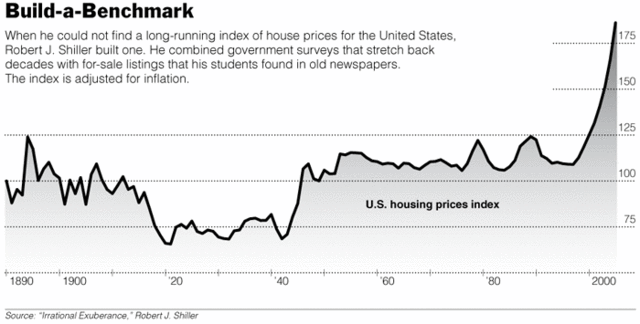
The rationalizations that I’m noticing from people who want to deny the existence of a housing bubble are becoming more obviously contrived.
Last spring, the strangest one I noticed was this Tyler Cowen post, which notes the unusual rent-buy ratios, then ignores that anomaly and devotes the rest of the post to questioning a weaker argument for the housing bubble theory.
This month I noticed someone on a private mailing list who had enough sense to realize that current housing prices probably depend on a continuation of unusually low and stable long-term interest rates expressed confidence that the “psychological consensus against inflation” would make that likely. If such a consensus existed, I would have expected to see people expressing concern that the Fed’s policy being too inflationary, when in fact I see people jumping at any excuse (e.g. a hurricane) to advocate a more inflationary policy. Plus I see politicians racing to expand the federal debt to levels that will give them massive incentives to inflate or default when the baby boomers retire.
Now Chris Hibbert comes up with some stranger rationalizations:
The worst historical cases that I know of were times when housing prices dropped 10 or 20 percent.
I thought he read Marginal Revolution regularly, but that comment suggests he is unaware of this description of Shiller’s apparently more accurate housing price history which includes what looks like a 50 percent drop in U.S. housing prices. But that deals with a national average, which gives you the kind of diversification you might get with a mutual fund. Chris’s real estate investments sound less diverse – is that safer?
Continue Reading
Brad Setser has a disturbing post about the risks that the hedge fund industry is taking, and which might cause a market crash. Puts are looking cheap these days, and I’m buying a modest amount of them just in case.
I was recently surprised to discover that California has price controls which are designed to encourage hoarding in emergencies and to discourage stockpiling in preparation for emergencies. The law in question is called an anti-gouging law, and temporarily limits price increases to 10 percent in some emergencies. I’ve seen conflicting reports about whether Bush’s declaration of emergency triggers the price controls, or whether it requires a state declaration of emergency. The governator has indicated that he has no plans to join the Bush/Lockyer exploitation of Katrina, but my limited observations suggest that gas stations in the bay area have limited their gas prices increases to 10 percent, and a few of them ran out of gas over the weekend.
It looks like the gas supply problems will ease soon enough that the price controls won’t have done much harm this time (diversions of gas shipments that were intended for other parts of the world will any week now spread the supply reduction over large enough regions that a fairly small price premium over what would have prevailed without Katrina should keep supply and demand in balance).
On a related note, Alex Tabarrok made a claim that suspending gas taxes won’t help consumers. I’m suspicious of his belief that a temporary suspension will have little effect on supply. I expect that oil companies will have an important incentive to draw down their inventory more than they otherwise would, especially just before the taxes are reinstated (since their profit margins will decline when taxes resume). I expect this effect to reduce prices to consumers by a modest fraction of the amount of tax relief. This will come at the cost of increased vulnerability to new supply disruptions. I doubt that the voters who have caused politicians to suspend gas taxes have given much thought to the wisdom of this tradeoff.
Robin Hanson writes in a post on Intuition Error and Heritage:
Unless you can see a reason to have expected to be born into a culture or species with more accurate than average intuitions, you must expect your cultural or species specific intuitions to be random, and so not worth endorsing.
Deciding whether an intuition is species specific and no more likely than random to be right seems a bit hard, due to the current shortage of species whose cultures address many of the disputes humans have.
The ideas in this quote follow logically from other essays of Robin’s that I’ve read, but phrasing them this way makes them seem superficially hard to reconcile with arguments by Hayek that we should respect the knowledge contained in culture.
Part of this apparent conflict seems to be due to the Hayek’s emphasis on intuitions for which there is some unobvious and inconclusive evidence that supports the cultural intuitions. Hayek wasn’t directing his argument to a random culture, but rather to a culture for which there was some evidence of better than random results, and it would make less sense to apply his arguments to, say, North Korean society. For many other intuitions that Hayek cared about, the number of cultures which agree with the intuition may be large enough to constitute evidence in support of the intuition.
Some intuitions may be appropriate for a culture even though they were no better than random when first adopted. Driving on the right side of the road is a simple example. The arguments given in favor of a judicial bias toward stare decisis suggest this is just the tip of an iceberg.
Some of this apparent conflict may be due the importance of treating interrelated practices together. For instance, laws against extramarital sex might be valuable in societies where people depend heavily on marital fidelity but not in societies where a divorced person can support herself comfortably. A naive application of Robin’s rule might lead the former society to decide such a law is arbitrary, when a Hayekian might wonder if it is better to first analyze whether to treat the two practices as a unit which should only be altered together.
I’m uncertain whether these considerations fully reconcile the two views, or whether Hayek’s arguments need more caveats.
Book Review: Freakonomics : A Rogue Economist Explores the Hidden Side of Everything by Steven D. Levitt
This book does a pretty good job of tackling subjects that are worth thinking about but which few would think to tackle. Their answers are interesting but not always as rigorous as I hoped.
The implication that this is an economics book is a bit misleading. While it is occasionally guided by the principle that incentives matter, it is at least as much about Kelvinism (the belief that we ought to quantify knowledge whenever possible), but then some of the book consists of stories which have little to do with either.
My favorite parts of the book explore the extent to which experts’ incentives cause them to pursue goals that don’t coincide with their clients’ interests. But his arguments about realtors exaggerate the extent of their conflict of interest – it is likely that part of the reason they are quick to sell a client’s house more cheaply than they would sell their own is that the realtor is less likely to need to sell by a deadline.
I am left puzzled by the claim that crack gang leaders want to avoid gang wars, but gang members are rewarded for starting violence with promotions. Who’s controlling the rewards if it isn’t the leader? Why can’t he ensure that members who engage in nondefensive violence aren’t promoted?
Two years ago a DARPA project was canceled after some demagogues attacked a straw man which bore a superficial resemblance to the actual project. Now Robin Hanson (who had some involvement with the project) has written a defense of the straw man, i.e. an argument that futures markets might be of some value a predicting specific features of terrorist attacks (although not nearly as valuable as more natural uses of futures markets such as predicting the effects of changes in Homeland Security budgets on the harm done by terrorism).
He has a somewhat plausible argument that there is useful information out there that might be elicited by markets, particularly concerning the terrorist choice of method and targets. An important part of his argument is that in order to be useful, the markets might only need to distinguish one-in-a-thousand risks from one-in-a-million risks. One weakness in this argument is that it makes mildly optimistic assumptions about how reasonably people will respond to the information. There is clear evidence much spending that is advertised as defense against terrorism is spent on pork instead. Markets that provide a few bits of information about which targets need defending will raise the cost of that pork-barrel spending, but I can’t tell whether the effect will be enough to meet whatever threshold is needed to have some effect.
The section on moral hazard seems to contain a rather strange assumption about the default level of trader anonymity. The “reduced” level he talks about seems to be about as much as the U.S. government would allow. It isn’t clear to me whether any anonymity helps make the prices more informative (does anyone know of empirical tests of this?). The optimal level of anonymity might vary from issue to issue according to what kind of trader has the best information.
The proposal to hide some prices is more difficult than it sounds (not to mention that it’s far from clear that the problems it would solve are real). Not only would the exchange need to delay notifying traders of the relevant trades, but it would need to delay notifying them of how the trades affected the traders’ cash/credit available for trading other futures. Which would often deter traders from trying to trade when prices are hidden (it’s also unclear whether the trades that would be deterred would add useful information). In addition, I expect many of the futures that would be traded would be about targets and/or methods covering some broad range of time; it’s unclear how to apply a condition about “attacks to occur within the next week” to those.
The proposals to deal with decision selection bias sound politically difficult to implement (unless maybe Futarchy has been substantially implemented). But there isn’t much risk to experimenting with them, and elected officials probably don’t have the attention span to understand the problem, so there probably isn’t much reason to worry about this.
Book Review: Intangibles: Management, Measurement, and Reporting by Baruch Lev
It isn’t easy to make a book about accounting interesting and uplifting, but this book comes fairly close to accomplishing that. It provides a clear understanding of why it matters how well accounting rules treat intangible assets, and gives some good guidelines on how to improve them.
Some of the proposed improvements are fairly easy to evaluate, such as breaking down R&D into subcategories for basic research, improvements to recently released products, etc., but with some of the book’s suggestions (e.g. trademarks) I’m puzzled as to whether there’s little to be gained or whether he has a good idea that he hasn’t adequately explained.
Alas, accounting standards are a public good that few people have an incentive to create. The improvements suggested by the book could generally be adopted without first being approved by a standards committee because they mostly involve adding new information to reports. But the first company to adopt them gains little until investors can compare the information with that from other companies. And accounting standards committees tend to attract people whose main concern is preventing harm rather than creating new value. And that tendency is currently being reinforced by investors who want a scapegoat for their complacency at the peak of the recent stock market bubble.
I’m curious how U.S. politicians are rationalizing their support for tariffs to punish China for keeping the yuan high (i.e. propping up the dollar). There’s an obvious alternative if it’s as clear as most people claim that the yuan is undervalued: have the U.S. government buy as many yuan as it can. That would make it more expensive for China to keep the yuan down at a probable profit to the U.S.
There may be some Chinese rules which pose obstacles to doing this, but I doubt the U.S. politicians are able to know that they couldn’t get around such rules.
Note that I didn’t ask what their real motives are (tariffs benefit special interests more than buying the yuan would, which provides a strong hint). I’m interested in what excuses they would give.