The Bush administration’s abuse of innocent Muslims hasn’t been getting as much coverage as it deserves, so I’m encouraging you all to spread the word about this account of the government’s continuing abuse of Muslims that it admitted months ago were innocent (thanks to Andrew Sullivan).
What is Congress doing about this boost to Al Qaeda’s recruitment efforts? Trying to restrict the habeas corpus rights of the victims so that we don’t hear about them.
Archives
All posts by Peter
Monopolies tend to become insensitive bureaucracies, and governments tend to be some of the most monopolistic entities around. (If you think of monopolies as bad only because they get monopoly profits, or think other kinds of harm are avoidable given monopoly power, I recommend reading Lessig’s book The Future of Ideas : The Fate of the Commons in a Connected World). Democracy has sometimes been effective at reducing the extent to which governments have acted as monopolies, by creating competition between factions. In recent years, gerrymandering has virtually eliminated that competition for many legislative bodies.
California Proposition 77 would eliminate the conflicts of interest that make current gerrymandering a major threat to democracy, and would give us instead something that works more like our judicial system. Our judicial system isn’t ideal, but it’s better than what a legislature does when the voters are unable to influence the legislature.
Critics have complained that Prop 77 is imperfect, but haven’t provided a clear explanation of why the alleged imperfections could be considered large in comparison to the difference between the current gerrymandering and a competitive democracy, or why it would be harder to adopt improvements to Prop 77 later than it is to adopt it now.
For a while now I’ve been bothered by the absence of an eloquent phrase for monopolies on ideas that doesn’t perpetuate the recent claim that those monopolies deserve the same respect as ownership of physical objects. That claim has caused some presumptions which distort discussion of copyrights and patents, and lead to thoughtless conclusions such as this attack on Google’s Print Library (a project which sounds like it will respect copyrights more carefully than Google’s main search engine does).
Eric Drexler recently mentioned that “intellectual pseudo property” is an appropriate term, and pointed out that many of the rules it refers to are more like a lease than ownership. Apparently Markus Krummenacker used the phrase first (without a succinct argument that it should replace the phrase intellectual property).
Finally someone has produced a quantitative measure that tests the ideological biases of supreme court justices, and it shows a good deal of bias. It looks more like a collection of small biases rather than a simple polarization into left and right.
An article titled Alito isn’t “pro-life” or “pro-choice” but “pro-law.” by Jon Adler (who I knew when he was an undergrad and whose opinions I respect) has led me to believe that Alito will be less influenced by his personal biases than the average justice.
Several posts on EconLog recently have assumed that human capital will be sufficient for their children to prosper in a Kurzweilian future.
That is a very risky assumption. Human capital has historically been a good investment largely because there have been few innovations that made it easier to produce more humans. Kurzweil’s forecasts imply that around 2040 or 2050 the cost of duplicating a human-equivalent intelligence will plunge. Which means that for most kinds of jobs, the supply of labor should be expected to become nearly unlimited, and in the absence of substantial monopoly, we should expect the price of labor under a Kurzweil scenario to approach zero. Maybe something will guarantee everyone a luxurious lifestyle in a world where there’s little reason for salaries, but I’d rather hedge my bets and accumulate financial assets.
See Robin Hanson’s analysis for a more detailed argument.
I’ve found most of the “debates” on gay marriage annoying because most of the debaters seem eager to show off their ignorance of what their opponents believe. But Maggie Gallagher recently attempted to change this, and managed to provoke an excellent response from Reason’s Julian Sanchez which directly targets the marriage-for-procreation ideal, showing that in addition to lacking strong arguments in its favor, that traditionalists are wrong to claim that was once the sole motive for having such an institution.
Book Review: The God Gene : How Faith Is Hardwired into Our Genes by Dean H. Hamer
This book is entertaining but erratic. To start with, the title is misleading. The important parts of the book are about spirituality (as in what Buddhists seek), which has little connection with God or churches. He does a moderately good job of describing evidence that he has identified a gene that influences spirituality. He makes plausible claims that spirituality makes people happy (that part of the book resembles the works of Csikszentmihalyi and Seligman). He makes a half-hearted attempt to argue that spirituality has evolutionary advantages which isn’t very convincing by itself, but in combination with the sexual selection arguments in Miller’s book The Mating Mind it becomes moderately plausible.
About halfway through the book, he runs out of things to say on those subjects and proceeds to wander through a bunch of marginally related subjects.
His descriptions of psilocybin, prozac, and ecstasy were interesting enough to make me want to learn more about those and similar drugs.
His claims that placebos are effective seem very exaggerated (see this abstract).
The CFTC has reacted to Tradesports‘ futures-like contracts that many U.S. residents have been trading without CFTC regulation.
It is surprising how closely the contracts that they objected to coincide with contracts traded under CFTC regulation – they apparently have prohibited Tradesports from offering to U.S. residents contracts on the results of the next Fed meeting (which Hedgestreet trades under CFTC regulation; Tradesports stopped offering these in May, possibly due to negotiations with the CFTC) but as far as I can tell Tradesports is still able to offer contracts on where the Fed Funds rate will be at the end of the year.
I am also surprised that the CFTC classified the contracts as futures options rather than futures. They do have something resembling as strike price, but otherwise resemble a futures contract more than they resemble an option.
Book Review: Unconventional Success : A Fundamental Approach to Personal Investment by David F. Swensen
This book provides some good advice on how an amateur investor can avoid sub-par results with a modest amount of work. It starts by describing why good asset allocation rules should be the primary concern of the typical person.
I found this quote especially wise: “While hot stocks and brilliant timing make wonderful cocktail party chatter, the conversation-stopping policy portfolio proves far more important to investment success.” Fortunately for those of us who make a living exploiting the mispricing of fad-chasing investors, the most valuable points of this book aren’t in the kind of sound bite that will make them popular at cocktail parties.
But even if you choose investment ideas for cocktail party conversation rather than for building wealth, you should be able to find some value in his explanations of how to avoid being ripped off by fund salesmen and why ETFs are better than most mutual funds.
His attacks on the mutual fund industry are filled with redundant vitriol that may cause some readers to quit in the middle. If you do so, don’t miss table 11.3, which gives an excellent list of ETFs that most investors should use. I was surprised at how much I learned about the differences between good and bad ETFs from this book.
His arguments against investing in foreign bond funds are weak. I suspect he overestimates the degree to which foreign equities diversify exposure to currency risks.
He advises investing more in U.S. equities than in equities of the rest of the world combined, even though his reasoning implies more diversification would be better. But I’ve been slow enough to diversify my own investments this way that I guess I can’t fault him too severely.
He has a plausible claim that not-for-profit organizations that provide investment vehicles on average treat customers more fairly than for-profit funds do, he goes overboard when he claims not-for-profits have no conflict of interest. The desires for job security and large salaries create incentives that would cause many investors to be fleeced if they switched to not-for-profits without becoming more vigilant than they have been.
His faith in the U.S. government is even more naive. He says “U.S. Treasury Inflation-Protected Securities, which provide ironclad assurance against inflation-induced asset erosion”, “Treasury … bondholders face no risk of default”, and “The interests of Treasury bond investors and the U.S. government prove to be better aligned than the interests of corporate bond investors and corporate issuers. The government sees little reason to disfavor bondholders.” But a close look at the CPI shows that indexing to it provides very imperfect inflation protection (e.g. its focus on rents hides the effects of rising home prices), and the current reckless spending policies combined with large foreign holdings of U.S. bonds can hardly avoid creating a motive for future politicians to inflate wildly or default.
The rationalizations that I’m noticing from people who want to deny the existence of a housing bubble are becoming more obviously contrived.
Last spring, the strangest one I noticed was this Tyler Cowen post, which notes the unusual rent-buy ratios, then ignores that anomaly and devotes the rest of the post to questioning a weaker argument for the housing bubble theory.
This month I noticed someone on a private mailing list who had enough sense to realize that current housing prices probably depend on a continuation of unusually low and stable long-term interest rates expressed confidence that the “psychological consensus against inflation” would make that likely. If such a consensus existed, I would have expected to see people expressing concern that the Fed’s policy being too inflationary, when in fact I see people jumping at any excuse (e.g. a hurricane) to advocate a more inflationary policy. Plus I see politicians racing to expand the federal debt to levels that will give them massive incentives to inflate or default when the baby boomers retire.
Now Chris Hibbert comes up with some stranger rationalizations:
The worst historical cases that I know of were times when housing prices dropped 10 or 20 percent.
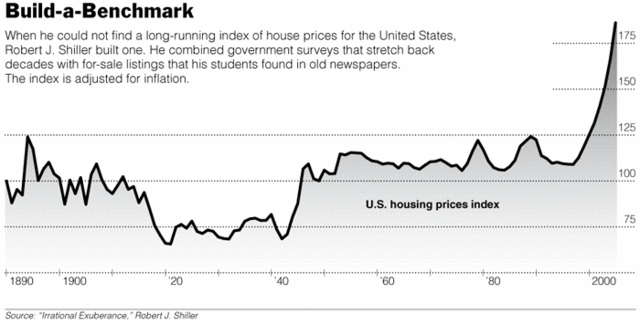
I thought he read Marginal Revolution regularly, but that comment suggests he is unaware of this description of Shiller’s apparently more accurate housing price history which includes what looks like a 50 percent drop in U.S. housing prices. But that deals with a national average, which gives you the kind of diversification you might get with a mutual fund. Chris’s real estate investments sound less diverse – is that safer?
Continue Reading