 A Different Universe: Reinventing Physics from the Bottom Down
Robert Laughlin
A Different Universe: Reinventing Physics from the Bottom Down
Robert Laughlin
"[An] important, brain-tickling new book.... Laughlin's thesis is intriguing." (New York Times Book Review)
In this age of superstring theories and Big Bang cosmology, we're used to thinking of the unknown as impossibly distant from our everyday lives. But in A Different Universe, Nobel Laureate Robert Laughlin argues that the scientific frontier is right under our fingers. Instead of looking for ultimate theories, Laughlin considers the world of emergent properties-meaning the properties, such as the hardness and shape of a crystal, that result from the organization of large numbers of atoms. Laughlin shows us how the most fundamental laws of physics are in fact emergent. A Different Universe is a truly mind-bending book that shows us why everything we think about fundamental physical laws needs to change.
"I started reading and, clichŽ though it be, I couldn't stop. Despite the Nobel, Laughlin has an appealing, anarchic kind of sanity, and his company through this vivid and entertaining book is inspirational. A Different Universe should be required reading for physics researchers, teachers and students." (New Scientist)
"Peppered with his imaginative illustrations, analogies and anecdotes." (Philadelphia Inquirer)
 The Mental Floss History of the World: An Irreverent Romp Through Civilization's Best Bits
Erik Sass, Steve Wiegand, Editors Of Mental Floss
The Mental Floss History of the World: An Irreverent Romp Through Civilization's Best Bits
Erik Sass, Steve Wiegand, Editors Of Mental Floss
Pop quiz! Who said what about history?
History is . . .
(a) more or less bunk.
(b) a nightmare from which I am trying to awaken.
(c) as thoroughly infected with lies as a street whore with syphilis.
Match your answers:
(1) Stephen Daedalus of James Joyce's Ulysses
(2) Henry Ford
(3) Arthur Schopenhauer
It turns out that the answer need not be bunk, nightmarish, or diseased. In the hands of mental_floss, history's most interesting bits have been handpicked and roasted to perfection. Packed with little-known stories and outrageous—but accurate—facts, you'll laugh yourself smarter on this joyride through 60,000 years of human civilization.
Remember: just because it's true doesn't mean it's boring!
Now with Breaking News
"If You Thought the Last Depression Was Great . . ."
Answers: (a) 2 (b) 1 (c) 3
 The Last Hero: A Discworld Fable
Terry Pratchett, Paul Kidby
The Last Hero: A Discworld Fable
Terry Pratchett, Paul Kidby
Cohen the Barbarian.
He's been a legend in his own lifetime.
He can remember the good old days of high adventure, when being a Hero meant one didn't have to worry about aching backs and lawyers and civilization.
But these days, he can't always remember just where he put his teeth...
So now, with his ancient (yet still trusty) sword and new walking stick in hand, Cohen gathers a group of his old — very old — friends to embark on one final quest. He's going to climb the highest mountain of Discworld and meet the gods.
It's time the Last Hero in the world returns what the first hero stole. Trouble is, that'll mean the end of the world, if no one stops him in time.
 Fleet of Worlds
Larry Niven, Edward M. Lerner
Fleet of Worlds
Larry Niven, Edward M. Lerner
Humanity has been faithfully serving the Citizens for years, and Kirsten Quinn-Kovacks is among the best and the brightest of the humans. She gratefully serves the race that rescued her ancestors from a dying starship, gave them a home world, and nurtures them still. If only the Citizens knew where Kirsten’s people came from.
A chain reaction of supernovae at the galaxy’s core unleashes a wave of lethal radiation that will sterilize the galaxy. The Citizens flee, taking their planets, the Fleet of Worlds, with them.
Someone must scout ahead, and Kirsten and her crew eagerly volunteer. Under the guiding eye of Nessus, their Citizen mentor, they explore for any possible dangers in the Fleet’s path—and uncover long-hidden truths that will shake the foundations of worlds. Fleet of Worlds marks Larry Niven's first novel-length collaboration within his Known Space universe, the playground he created for his bestselling Ringworld series. Teaming up with fellow SF writer Edward M. Lerner, Fleet of Worlds takes a closer look at the Human-Puppeteer (Citizens) relations and the events leading up to Niven's first Ringworld novel.
 Neverwhere
Neil Gaiman
Neverwhere
Neil Gaiman
Richard Mayhew is a plain man with a good heart — and an ordinary life that is changed forever on a day he stops to help a girl he finds bleeding on a London sidewalk.From that moment forward he is propelled into a world he never dreamed existed — a dark subculture flourish in abandoned subway stations and sewer tunnels below the city — a world far stranger and more dangerous than the only one he has ever known...Richard Mayhew is a young businessman with a good heart and a dull job. When he stops one day to help a girl he finds bleeding on a London sidewalk, his life is forever altered, for he finds himself propelled into an alternate reality that exists in a subterranean labyrinth of sewer canals and abandoned subway stations below the city. He has fallen through the cracks of reality and has landed somewhere different, somewhere that is Neverwhere.
 The Player of Games
Iain M. Banks
The Player of Games
Iain M. Banks
The Culture - a human/machine symbiotic society - has thrown up many great Game Players, and one of the greatest is Gurgeh. Jernau Morat Gurgeh. The Player of Games. Master of every board, computer and strategy. Bored with success, Gurgeh travels to the Empire of Azad, cruel and incredibly wealthy, to try their fabulous game...a game so complex, so like life itself, that the winner becomes emperor. Mocked, blackmailed, almost murdered, Gurgeh accepts the game, and with it the challenge of his life - and very possibly his death.
Praise for Iain M. Banks:
"Poetic, humorous, baffling, terrifying, sexy — the books of Iain M. Banks are all these things and more" — NME
"An exquisitely riotous tour de force of the imagination which writes its own rules simply for the pleasure of breaking them." — Time Out
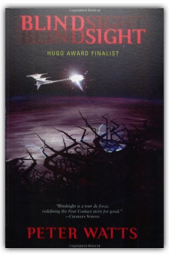 Blindsight
Peter Watts
Blindsight
Peter Watts
The Hugo Award–nominated novel by “a hard science fiction writer through and through and one of the very best alive.” —The Globe and Mail Two months have past since a myriad of alien objects clenched about the Earth, screaming as they burned. The heavens have been silent since—until a derelict space probe hears whispers from a distant comet. Something talks out there: but not to us. Who should we send to meet the alien, when the alien doesn’t want to meet? Send a linguist with multiple-personality disorder and a biologist so spliced with machinery that he can’t feel his own flesh. Send a pacifist warrior and a vampire recalled from the grave by the voodoo of paleogenetics. Send a man with half his mind gone since childhood. Send them to the edge of the solar system, praying you can trust such freaks and monsters with the fate of a world. You fear they may be more alien than the thing they’ve been sent to find—but you’d give anything for that to be true, if you knew what was waiting for them. . . . Peter Watts lives in Toronto, Canada.
The Hugo Award–nominated novel by "a hard science fiction writer through and through and one of the very best alive."—The Globe and Mail
Two months have past since a myriad of alien objects clenched about the Earth, screaming as they burned. The heavens have been silent since—until a derelict space probe hears whispers from a distant comet. Something talks out there: but not to us. Who should we send to meet the alien, when the alien doesn’t want to meet?
Send a linguist with multiple-personality disorder and a biologist so spliced with machinery that he can’t feel his own flesh. Send a pacifist warrior and a vampire recalled from the grave by the voodoo of paleogenetics. Send a man with half his mind gone since childhood. Send them to the edge of the solar system, praying you can trust such freaks and monsters with the fate of a world. You fear they may be more alien than the thing they’ve been sent to find—but you’d give anything for that to be true, if you knew what was waiting for them.
"The genius of Blindsight is that its author has been clever enough to build a story that demonstrates [his] case . . . Much of the narrative pleasure of Blindsight comes from a conjoined experience of doubled discovery: as we gradually get to understand the nature of the crew . . . we find ourselves simultaneously beginning to get some sense of the alien species orbiting Ben in something . . . that Watts describes in terms that evoked, for me, some great, granulated, anfractuous rat king of shrikes multiplied a thousandfold from the simple single shrike out of Dan Simmons’s Hyperion, which so goosed my midbrain . . . It is a sign of the pervasive toughness of Blindsight that its human readers can take pleasure in [the] message, because what the scramblers say to us in the end is, ‘Shut up.’"—The New York Review of Science Fiction
"Trained as a marine biologist, Watts is completely at ease using his richly developed characters to spin possibilities and theories on the cutting edge of science. His dense idea storms may slow some readers, but most will sail through the tech-heavy patches purely for the thrill of seeing what happens next."—Gwenda Bond, The Washington Post
"This is a a very ambitious story, very successfully done. As a novel, it’s gripping enough that my last-weekend glance to fill in details became a complete rereading. Rare that, but this is a rare book."—The San Diego Union-Tribune
"A brilliant piece of work, one that will delight fans of hard science fiction, but will also demonstrate to literary fans that contemporary science fiction is dynamic and fascinating literature that demands to be read."—The Edmonton Journal
"Challenging . . . fascinating and rewarding. Watts’ all-but-declared literary ambition is to be a first-class hard science fiction writer on the sophisticated literary level of Gregory Benford or Arthur C. Clarke. And with Starfish, Maelstrom, Behemoth, and now Blindsight, he demonstrates that he can achieve it."—Asimov’s Science Fiction magazine
"Watt’s dark, suspenseful, nightmarish vision of intelligent life in a hostile universe is remorseless in its outlook and unflinching in its conclusions."—SF Site
"Extremely thought-provoking, taking its premise to the ultimate conclusion, showing that the alien without might by closely related to the alien within."—Interzone
"A first-contact novel notable for the utter remorselessness of it commitment to its central premise."—Vector
"A fascinating first-contact tale. This is a provocative exploration of the nature of human consciousness and what it means to be human."—Romantic Times BOOKreviews
"A swarm of Fireflies lighted alien objects in the sky now orbits Earth, speaking among themselves and ignoring human attempts at communication. In desperation, a group consisting of a linguist with multiple personality disorder, a biologist more machine than man, a paleogenetic vampire, and a pacifist is sent to confront this unfathomable alien presence. Watts (aehemoth) continues to challenge readers with his imaginative plots and superb storytelling. A good choice for most sf collections."—Library Journal
"Alien-contact tale in which humans are at least as weird as the aliens. Eighty years from now, denizens of Earth become aware of an alien presence when the sky fills with bursts of light from dying Fireflies, tiny machines that signal to a supergiant planet far beyond the edge of the solar system. With orders to investigate, the vessel Theseus carries an artificial intelligence as its captain, along with expedition leader Jukka Sarasti, a brooding, sociopathic and downright scary vampire; Isaac Szpindel, a biologist so mechanized he can barely feel his own skin; the Gang of Four, a schizophrenic linguist; curiously passive warrior Major Amanda Bates; and observer-narrator Siri Keeton, a synthesist with half a brain (the remainder destroyed by a virus) enhanced by add-ons and advanced algorithms. They meet a huge alien vessel that calls itself Rorschach and talks eagerly but says nothing of consequence. Indeed, the Gang of Four suspects that the alien voice isn't truly sentient at all. As Keeton begins to hallucinate, Sarasti orders a team to break into the alien vessel despite its lethal radiation levels. Still unable to decide whether the aliens are hostile, Sarasti devises a plan to capture one of the creatures that apparently thrive within Rorschach's peculiar environment. They succeed in grabbing two specimens. These scramblers, dubbed Stretch and Clench, resemble huge, bony, multi-limbed starfish. They have no brains but show evidence of massive information-processing capability, which brings Theseus' crew to the crucial question: Can intelligence exist without self-awareness? Watts carries several complications too many, but presents nonetheless asearching, disconcerting, challenging, sometimes piercing inquisition."—Kirkus Reviews
"Canadian author Watts explores the nature of consciousness in this stimulating hard SF novel, which combines riveting action with a fascinating alien environment. In the late 21st century, when something alien is discovered beyond the edge of
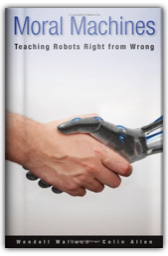 Moral Machines: Teaching Robots Right from Wrong
Wendell Wallach, Colin Allen
Moral Machines: Teaching Robots Right from Wrong
Wendell Wallach, Colin Allen
Computers are already approving financial transactions, controlling electrical supplies, and driving trains. Soon, service robots will be taking care of the elderly in their homes, and military robots will have their own targeting and firing protocols. Colin Allen and Wendell Wallach argue that as robots take on more and more responsibility, they must be programmed with moral decision-making abilities, for our own safety. Taking a fast paced tour through the latest thinking about philosophical ethics and artificial intelligence, the authors argue that even if full moral agency for machines is a long way off, it is already necessary to start building a kind of functional morality, in which artificial moral agents have some basic ethical sensitivity. But the standard ethical theories don't seem adequate, and more socially engaged and engaging robots will be needed. As the authors show, the quest to build machines that are capable of telling right from wrong has begun.
Moral Machines is the first book to examine the challenge of building artificial moral agents, probing deeply into the nature of human decision making and ethics.
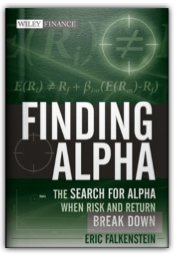 Finding Alpha: The Search for Alpha When Risk and Return Break Down
Eric Falkenstein
Finding Alpha: The Search for Alpha When Risk and Return Break Down
Eric Falkenstein
Praise for Finding Alpha
"Eric Falkenstein is more than one of the smartest and funniest people in finance. He's been a banker, a key model builder at a major rating agency, and a hedge fund trader. In this tour de force, he outlines the successes and failures of financial theory applications in the real world from the perspective of an aggressive early adopter of the best ideas in finance. To this day, I think Eric's private firm default model is one of the best papers ever published in applied finance, and this wonderful book falls into the same category."
—Donald R. van Deventer, PhD, founder and Chief Executive Officer, Kamakura Corporation
"People dismissed Columbus when he said the world was round. Thank goodness he persisted. Like Columbus, Falkenstein challenges standard thinking, only this time about risk and reward. As the meltdown of the capital markets has shown, the financial industry clearly missed something with regard to risk management. As an industry, we need to consider alternative theories on risk, and clearly Falkenstein is on to something here. Agree with him or not, Finding Alpha is worth a read."
—Kevin M. Blakely, President and CEO,The Risk Management Association
"Writing through the lens of an experienced practitioner, Falkenstein digests decades of research in capital markets, financial economics, and investment psychology that have shaped modern investment theory. This text is an excellent companion for portfolio managers, investment students, or anyone seeking to better understand the relationship between risk, returns, and financial reward."
—Todd Houge, PhD, CFA, The University of Iowa
How do we find alpha whenrisk does not correlate with return?
Finding Alpha is a practical guide to achieving alpha when conventional measures of risk rarely correlate with higher returns. Author Eric Falkenstein-a PhD who has also been a risk manager and portfolio manager—tells the story of alpha from its beginnings to its current reversal, where risk is now evidenced by return as opposed to vice versa.
Falkenstein begins by walking readers through the Capital Asset Pricing Model (CAPM), as well as other well-documented theories about risk and return, and explores how these theories measure up to current empirical evidence being documented by researchers and academics. He also outlines a novel approach to the issues of how benchmark risk and investor overconfidence affects expected asset returns, how to understand the nature of alpha and risk, and how to use practical applications of alpha-seeking strategies that he developed as a successful hedge fund manager.
Finding Alpha concludes by outlining some real-life applications of alpha in finance and explains how the search for alpha affects the day-to-day life of all financial professionals.
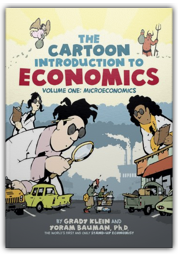 The Cartoon Introduction to Economics: Volume One: Microeconomics
Yoram Bauman
The Cartoon Introduction to Economics: Volume One: Microeconomics
Yoram Bauman
The award-winning illustrator Grady Klein has paired up with the world’s only stand-up economist, Yoram Bauman, PhD, to take the dismal out of the dismal science. From the optimizing individual to game theory to price theory, The Cartoon Introduction to Economics is the most digestible, explicable, and humorous 200-page introduction to microeconomics you’ll ever read. Bauman has put the “comedy” into “economy” at comedy clubs and universities around the country and around the world (his “Principles of Economics, Translated” is a YouTube cult classic). As an educator at both the university and high school levels, he has learned how to make economics relevant to today’s world and today’s students. As Google’s chief economist, Hal Varian, wrote, “You don’t need a brand-new economics. You just need to see the really cool stuff, the material they didn’t get to when you studied economics.” The Cartoon Introduction to Economics is all about integrating the really cool stuff into an overview of the entire discipline of microeconomics, from decision trees to game trees to taxes and thinking at the margin. Rendering the cool stuff fun is the artistry of the illustrator and lauded graphic novelist Klein. Panel by panel, page by page, he puts comics into economics. So if the vertiginous economy or a dour professor’s 600-page econ textbook has you desperate for a fun, factual guide to economics, reach for The Cartoon Introduction to Economics and let the collaborative genius of the Klein-Bauman team walk you through an entire introductory microeconomics course.
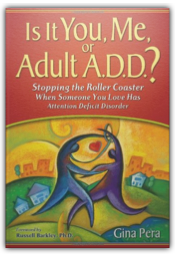 Is It You, Me, or Adult A.D.D.? Stopping the Roller Coaster When Someone You Love Has Attention Deficit Disorder
Gina Pera
Is It You, Me, or Adult A.D.D.? Stopping the Roller Coaster When Someone You Love Has Attention Deficit Disorder
Gina Pera
Winner of four national book awards, including Foreword Magazine's Psychology Book of the Year!
The science has been clear since 1994, when Adult AD/HD was declared a medical diagnosis. Still, the public harbors misconceptions, and that means millions suffer needlessly. And that includes millions of couples who can't understand why their lives together are so hard — sometimes despite many attempts at couples therapy.
Everyone knows someone with adult AD/HD. Yet we misattribute the symptoms to anxiety, depression, or even laziness, selfishness, or moodiness. Moreover, we assume AD/HD means "little boys with ants in their pants." In fact, childhood hyperactivity goes "underground" as the person matures, resulting in a mentally restless state. (By the way, the former, and still better-known, official term is ADD, plus or minus Hyperactivity. The new term, AD/HD, uses a slash mark to indicate that hyperactivity is not central to the diagnosis.)
Meticulously researched by award-winning journalist Gina Pera, Is It You, Me, or Adult A.D.D.? is a comprehensive guide to recognizing the behaviors where you least expect them (on the road and in the bedroom, for example) and developing compassion for couples wrestling with unrecognized ADHD symptoms. It also offers the latest information from top experts, plenty of real-life details, and easy-to-understand guidelines for finding the best treatment options and practical solutions. The revolutionary message is one of hope for millions of people—and a joyous opportunity for a better life.
Insightful, helpful, witty, and very practical. This book can change your life.
—Daniel G. Amen, M.D., author of Change Your Brain, Change Your Life
... contains information that is just not available anywhere else. This book is sure to become the authoritative guide for couples dealing with ADD.
—Patricia O. Quinn, M.D., Director, The National Center for Girls and Women with ADHD
...We expect this book will be the bible for all of us dealing with adult ADD.
— Elizabeth Weathers and Diane Hartson, moderators, ADD Spouse support group
... I can safely predict it will become as much an 'industry standard' as Driven to Distraction.
—David Edelberg, M.D., Medical Director, WholeHealth Chicago
... The book is well researched, reader friendly, and includes insights and perspectives from a Who's Who of professionals. For couples struggling with ADHD, it's the season's new must-have book and bound to become a classic.
—Michele Novotni, Ph.D. Psychologist, Coach
Confirmatory brain neuroscience answers this speculation about Adult ADHD: It s a real problem with real and painful challenges, not a belief system.
— Charles Parker, DO, Medical Director, CorePsych, author of Deep Recovery
... Gina Pera has combined a real feel for the disorder with sound reporting skills and the spice of those who tell the story best: the couples themselves.
— Margaret D. Weiss, M.D., Ph.D., Head, Provincial ADHD Program, British Columbia, Canada
... Gina Pera has been there and has authored a guide that offers understanding for the confused, practical strategies for the frustrated, and hope for the despondent. This book will be a lifesaver for both partners.
— Ari Tuckman, Psy.D., M.B.A., author of Integrative Treatment for Adult ADHD
|


 A.D.D. & Romance
Jonathan Halverstadt
A.D.D. & Romance
Jonathan Halverstadt
 Made with Delicious Library