 Born on a Blue Day: Inside the Extraordinary Mind of an Autistic Savant: A Memoir
Born on a Blue Day: Inside the Extraordinary Mind of an Autistic Savant: A Memoir Daniel Tammet 
 101 Ways to Improve Your Communication Skills Instantly, 4th Edition
101 Ways to Improve Your Communication Skills Instantly, 4th Edition Bennie Bough 

 Influence: The Psychology of Persuasion (Collins Business Essentials)
Influence: The Psychology of Persuasion (Collins Business Essentials) Robert B. Cialdini
 The 10,000 Year Explosion: How Civilization Accelerated Human Evolution
The 10,000 Year Explosion: How Civilization Accelerated Human Evolution Gregory Cochran/ Henry Harpending
 How to Communicate: The Ultimate Guide to Improving Your Personal and Professional Relationships
How to Communicate: The Ultimate Guide to Improving Your Personal and Professional Relationships Martha Davis/ Patrick Fanning/ Matthew McKay
 What Intelligence Tests Miss: The Psychology of Rational Thought
What Intelligence Tests Miss: The Psychology of Rational Thought Keith E. Stanovich PhD (Psychology)
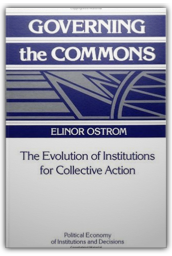 Governing the Commons: The Evolution of Institutions for Collective Action
Elinor Ostrom
Governing the Commons: The Evolution of Institutions for Collective Action
Elinor Ostrom

The governance of natural resources used by many individuals in common is an issue of increasing concern to policy analysts. Both state control and privatization of resources have been advocated, but neither the state nor the market have been uniformly successful in solving common pool resource problems. After critiquing the foundations of policy analysis as applied to natural resources, Elinor Ostrom here provides a unique body of empirical data to explore conditions under which common pool resource problems have been satisfactorily or unsatisfactorily solved. Dr. Ostrom first describes three models most frequently used as the foundation for recommending state or market solutions. She then outlines theoretical and empirical alternatives to these models in order to illustrate the diversity of possible solutions. In the following chapters she uses institutional analysis to examine different ways—both successful and unsuccessful—of governing the commons. In contrast to the proposition of the tragedy of the commons argument, common pool problems sometimes are solved by voluntary organizations rather than by a coercive state. Among the cases considered are communal tenure in meadows and forests, irrigation communities and other water rights, and fisheries.  To Hold Infinity
John Meaney
To Hold Infinity
John Meaney
Devastated by her husband’s death, Earth-based biologist Yoshiko Sunadomari journeys to the paradise world of Fulgar to see her estranged son in the hope of bridging the gulf between them. But Tetsuo is in trouble. His expertise in mu-space technology and family links with the mysterious Pilots have ensured his survival—so far. Now he’s in way over his head—unwittingly caught up in a conspiracy of illegal tech-trafficking and corruption, and in the sinister machinations of one of Fulgar’s ruling elite: the charismatic Luculentus, Rafael Garcia de la Vega. When his home is attacked, Tetsuo flees to the planet’s unterraformed wastes, home to society’s outcasts and eco-terrorists. So Yoshiko arrives on Fulgar to discover Tetsuo gone…and wanted for murder. Ill at ease in this strange, stratified new world seething with social and political unrest but desperate to find her son and clear his name, she embarks on a course of action that will bring her face to face with the awesome, malevolent mind of Rafael.  Beat the Market the Easy Way!
Sy Harding
Beat the Market the Easy Way!
Sy Harding
The real-time profits from this book's proven Seasonal Timing Strategy alone, even through the 2000-2002 bear market (with no down years) make it a must-own for every investor! And in it Sy Harding now introduces his new equally remarkable Presidential-Cycle Seasonal Strategy!  The Vondish Ambassador
Lawrence Watt-Evans
The Vondish Ambassador
Lawrence Watt-Evans
Once, not so long ago,a warlock named Vond built an empire in the southern part of the Small Kingdoms. Vond is gone, but his empire survives under the rule of a seven-person Imperial Council and a young regent named Sterren. 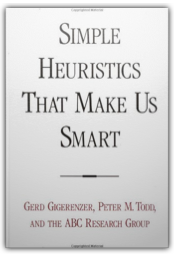 Simple Heuristics That Make Us Smart
Gerd Gigerenzer, Peter M. Todd, ABC Research Group
Simple Heuristics That Make Us Smart
Gerd Gigerenzer, Peter M. Todd, ABC Research Group
Simple Heuristics That Make Us Smart invites readers to embark on a new journey into a land of rationality that differs from the familiar territory of cognitive science and economics. Traditional views of rationality tend to see decision makers as possessing superhuman powers of reason, limitless knowledge, and all of eternity in which to ponder choices. To understand decisions in the real world, we need a different, more psychologically plausible notion of rationality, and this book provides it. It is about fast and frugal heuristics—simple rules for making decisions when time is pressing and deep thought an unaffordable luxury. These heuristics can enable both living organisms and artificial systems to make smart choices, classifications, and predictions by employing bounded rationality. |

 Made with Delicious Library
Mountain View, CA zipflap congrotus delicious library McCluskey, Peter