 New Dreams for Old
Mike Resnick
New Dreams for Old
Mike Resnick


New Dreams for Old is a collection of science fiction and fantasy stories by Mike Resnick, showing the depth and range that has not only made him a popular seller, but also placed him fourth (and climbing) on the all-time award list of all science fiction writers living and dead (as compiled by Locus). 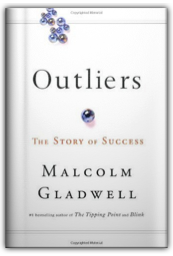 Outliers: The Story of Success
Malcolm Gladwell
Outliers: The Story of Success
Malcolm Gladwell

In this stunning new book, Malcolm Gladwell takes us on an intellectual journey through the world of "outliers"—the best and the brightest, the most famous and the most successful. He asks the question: what makes high-achievers different? His answer is that we pay too much attention to what successful people are like, and too little attention to where they are from: that is, their culture, their family, their generation, and the idiosyncratic experiences of their upbringing. Along the way he explains the secrets of software billionaires, what it takes to be a great soccer player, why Asians are good at math, and what made the Beatles the greatest rock band.  When Brute Force Fails: How to Have Less Crime and Less Punishment
Mark A. R. Kleiman
When Brute Force Fails: How to Have Less Crime and Less Punishment
Mark A. R. Kleiman
Since the crime explosion of the 1960s, the prison population in the United States has multiplied fivefold, to one prisoner for every hundred adults—a rate unprecedented in American history and unmatched anywhere in the world. Even as the prisoner head count continues to rise, crime has stopped falling, and poor people and minorities still bear the brunt of both crime and punishment. When Brute Force Fails explains how we got into the current trap and how we can get out of it: to cut both crime and the prison population in half within a decade.  This Time is Different: Eight Centuries of Financial Folly
Carmen M. Reinhart, Kenneth Rogoff
This Time is Different: Eight Centuries of Financial Folly
Carmen M. Reinhart, Kenneth Rogoff

Throughout history, rich and poor countries alike have been lending, borrowing, crashing—and recovering—their way through an extraordinary range of financial crises. Each time, the experts have chimed, "this time is different"—claiming that the old rules of valuation no longer apply and that the new situation bears little similarity to past disasters. This book proves that premise wrong. Covering sixty-six countries across five continents, This Time Is Different presents a comprehensive look at the varieties of financial crises, and guides us through eight astonishing centuries of government defaults, banking panics, and inflationary spikes—from medieval currency debasements to today's subprime catastrophe. Carmen Reinhart and Kenneth Rogoff, leading economists whose work has been influential in the policy debate concerning the current financial crisis, provocatively argue that financial combustions are universal rites of passage for emerging and established market nations. The authors draw important lessons from history to show us how much—or how little—we have learned.  What to Say When you Talk To Yourself
Shad Helmstetter
What to Say When you Talk To Yourself
Shad Helmstetter
You don't have to be crazy to talk to yourself! We all talk to ourselves all of the time, usually without realising it. And most of what we tell ourselves is negative, counterproductive and damaging, preventing us from enjoying a fulfilled and successful life. Shad Helmsetter's simple but profound techniques, based on an understanding of the processes of the human brain, have enabled thousands of people to get back in control of their lives. By learning how to talk to yourself in new ways, you will notice a dramatic improvement in all areas of your life. You will feel better and accomplish more. It will help you achieve more at work and at home, lose weight, overcome fears, stop smoking and become more confident. And it works. Shad Helmsetter, Ph.D, is a bestselling author of many personal growth books, and the leading authority in the field of Self-Talk.  Happiness from the Inside Out: The Art and Science of Fulfillment
Robert Mack
Happiness from the Inside Out: The Art and Science of Fulfillment
Robert Mack
Many think that happiness, like success, comes from getting what they want. But new evidence from positive psychology suggests that happiness is something else, or at least something more. Presenting surprisingly practical wisdom in a playful and entertaining format, Rob Mack delivers a simple-to-follow instruction manual, based in both science and personal experience, for living a happier, healthier, and wealthier life, starting today.  Human: The Science Behind What Makes Your Brain Unique
Michael S. Gazzaniga
Human: The Science Behind What Makes Your Brain Unique
Michael S. Gazzaniga
What happened along the evolutionary trail that made humans so unique? In his accessible style, Michael Gazzaniga pinpoints the change that made us thinking, sentient humans different from our predecessors. He explores what makes human brains special, the importance of language and art in defining the human condition, the nature of human consciousness, and even artificial intelligence.  Goodbye to Shy: 85 Shybusters That Work!
Leil Lowndes
Goodbye to Shy: 85 Shybusters That Work!
Leil Lowndes
Say hello to new friends, new business opportunities, new love, and new confidence  Impro: Improvisation and the Theatre
Keith Johnstone
Impro: Improvisation and the Theatre
Keith Johnstone
Impro ought to be required reading not only for theatre people generally but also for teachers, educators, and students of all kinds and persuasions. Readers of this book are not going to agree with everything in it; but if they are not challenged by it, if they do not ultimately succumb to its wisdom and whimsicality, they are in a very sad state indeed . . . .Johnstone seeks to liberate the imagination, to cultivate in the adult the creative power of the child . . . .Deserves to be widely read and tested in the classroom and rehearsal hall . . .Full of excellent good sense, actual observations and inspired assertions |o CHOICE: Books for College Libraries. 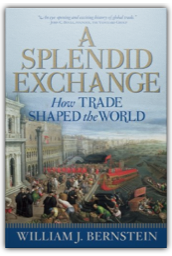 A Splendid Exchange: How Trade Shaped the World
William J. Bernstein
A Splendid Exchange: How Trade Shaped the World
William J. Bernstein
Adam Smith wrote that man has an intrinsic “propensity to truck, barter, and exchange one thing for another.” But how did trade evolve to the point where we don’t think twice about biting into an apple from the other side of the world? In this sweeping narrative history of world trade, William J. Bernstein tells the extraordinary story of global commerce from its prehistoric origins to the myriad controversies surrounding it today. He transports readers from ancient sailing ships that brought the silk trade from China to Rome in the second century to the rise and fall of the Portuguese monopoly in spices in the sixteenth; from the American trade battles of the early twentieth century to the modern era of televisions from Taiwan, lettuce from Mexico, and T-shirts from China. Lively, authoritative, and astonishing in scope, A Splendid Exchange is a riveting narrative that views trade and globalization not in political terms, but rather as an evolutionary process as old as war and religion—a historical constant—that will continue to foster the growth of intellectual capital, shrink the world, and propel the trajectory of the human species. 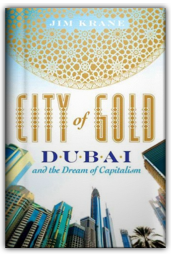 City of Gold: Dubai and the Dream of Capitalism
Jim Krane
City of Gold: Dubai and the Dream of Capitalism
Jim Krane
The city of Dubai, one of the seven United Arab Emirates, is everything the Arab world isn’t: a freewheeling capitalist oasis where the market rules and history is swept aside. Until the credit crunch knocked it flat, Dubai was the fastest-growing city in the world, with a roaring economy that outpaced China’s while luring more tourists than all of India. It’s one of the world’s safest places, a stone’s throw from its most dangerous. In City of Gold, Jim Krane, who reported for the AP from Dubai, brings us a boots-on-the-ground look at this fascinating place by walking its streets, talking to its business titans, its prostitutes, and the hard-bitten men who built its fanciful skyline. He delves into the city’s history, paints an intimate portrait of the ruling Maktoum family, and ponders where the city is headed. Dubai literally came out of nowhere. It was a poor and dusty village in the 1960s. Now it’s been transformed into the quintessential metropolis of the future through the vision of clever sheikhs, Western capitalists, and a river of investor money that poured in from around the globe. What has emerged is a tolerant and cosmopolitan city awash in architectural landmarks, luxury resorts, and Disnified kitsch. It’s at once home to America’s most prestigious companies and universities and a magnet for the Middle East’s intelligentsia. Dubai’s dream of capitalism has also created a deeply stratified city that is one of the world’s worst polluters. Wild growth has clogged its streets and left its citizens a tiny minority in a sea of foreigners. Jim Krane considers all of this and casts a critical eye on the toll that the global economic downturn has taken on a place that many tout as a blueprint for a more stable Middle East. While many think Dubai’s glory days have passed, insiders like Jim Krane who got to know the city and its creators firsthand realize there’s much more to come in the City of Gold, a place that, in just a few years, has made itself known to nearly every person on earth. 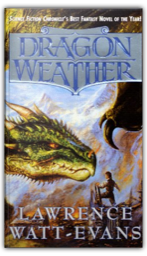 Dragon Weather
Lawrence Watt-Evans
Dragon Weather
Lawrence Watt-Evans
Arlian had never left his home village in the Obsidian Mountains. The green hills, white peaks, and black glass were all he had ever known of life, and though he dreamed of travel and adventure, he knew deep in his heart that he would probably never leave. |
 Made with Delicious Library
Mountain View, CA zipflap congrotus delicious library McCluskey, Peter