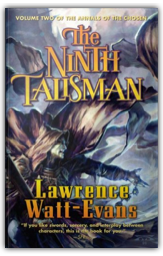
The Ninth Talisman Lawrence Watt-Evans  
More Details

All of the world is kept in a delicate balance under the supervision of the Wizard Lord. It is his duty to govern lightly and protect his domain…but if he should stray from the way of the just, then it is up to the Chosen to intercede.   The Chosen are the Leader, the Seer, the Swordsman, the Beauty, the Thief, the Scholar, the Archer, and the Speaker. These are magically infused mortal individuals who for the term of their service have only one function—to remove an errant Wizard Lord.    The Chosen fulfilled this role when they removed the previous Wizard Lord and exposed treachery from within their own ranks.

Since their last adventure, the world has returned to apparent peace and prosperity. The new Wizard Lord rules benevolently...but with an eye towards modernization through technology, instead of magic.    Do such plans jeopardize the delicate balance of power?
Is a Wizard Lord who is able to rule without magic a threat to the Chosen?

On What Matters: Volume I Derek Parfit  
More Details

On What Matters is a major work in moral philosophy. It is the long-awaited follow-up to Derek Parfit's 1984 book Reasons and Persons, one of the landmarks of twentieth-century philosophy. Parfit now presents a powerful new treatment of reasons, rationality, and normativity, and a critical examination of three systematic moral theories - Kant's ethics, contractualism, and consequentialism - leading to his own ground-breaking synthetic conclusion. Along the way he discusses a wide range of moral issues, such as the significance of consent, treating people as a means rather than an end, and free will and responsibility. On What Matters is already the most-discussed work in moral philosophy: its publication is likely to establish it as a modern classic which everyone working on moral philosophy will have to read, and which many others will turn to for stimulation and illumination.

The Hunger Games Suzanne Collins  
More Details

Now in paperback, the book no one can stop talking about . . .

In the ruins of a place once known as North America lies the nation of Panem, a shining Capitol surrounded by twelve outlying districts. The Capitol is harsh and cruel and keeps the districts in line by forcing them all to send one boy and one girl between the ages of twelve and eighteen to participate in the annual Hunger Games, a fight to the death on live TV. Sixteen-year-old Katniss Everdeen, who lives alone with her mother and younger sister, regards it as a death sentence when she is forced to represent her district in the Games. But Katniss has been close to dead (cont'd)

Wherever You Go, There You Are Jon Kabat-Zinn  
More Details

The time-honored national bestseller, updated with a new afterword, celebrating 10 years of influencing the way we live.

When Wherever You Go, There You Are was first published in 1994, no one could have predicted that the book would launch itself onto bestseller lists nationwide and sell over 750,000 copies to date. Ten years later, the book continues to change lives. In honor of the book's 10th anniversary, Hyperion is proud to be releasing the book with a new afterword by the author, and to share this wonderful book with an even larger audience.

Moon California Waterfalls: More Than 200 Falls You Can Reach by Foot, Car, or Bike Ann Marie Brown  
More Details

California outdoorswoman Ann Marie Brown covers the best of California’s waterfalls, from all areas of the state: Cascade Falls in Lake Tahoe, Limekiln Falls in Big Sur, and South Fork Kaweah Falls in Sequoia National Park, among others. Brown includes various travel strategies, including Top 5 Unusual Waterfalls and Top 5 Waterfalls at Family Campgrounds. Complete with expert tips such as which waterfalls are best accessed by foot, car, or bike, Moon California Waterfalls gives travelers the tools they need to create a more personal and memorable experience.
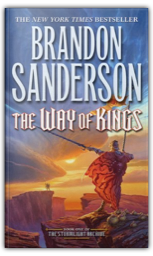
The Way of Kings Brandon Sanderson  
More Details

Brandon Sanderson, widely acclaimed for his work completing Robert Jordan’s Wheel of Time saga,  begins a grand cycle of his own, with The Way of Kings, Book One of the Stormlight Archive.
Roshar is a world of stone and storms. Uncanny tempests of incredible power sweep across the rocky terrain so frequently that they have shaped ecology and civilization alike. Animals hide in shells, trees pull in branches, and grass retracts into the soilless ground. Cities are built only where the topography offers shelter.

It has been centuries since the fall of the ten consecrated orders known as the Knights Radiant, but their Shardblades and Shardplate remain: mystical swords and suits of armor that transform ordinary men into near-invincible warriors. Men trade kingdoms for Shardblades. Wars were fought for them, and won by them.

One such war rages on a ruined landscape called the Shattered Plains. There, Kaladin, who traded his medical apprenticeship for a spear to protect his little brother, has been reduced to slavery. In a war that makes no sense, where ten armies fight separately against a single foe, he struggles to save his men and to fathom the leaders who consider them expendable.

Brightlord Dalinar Kholin commands one of those other armies. Like his brother, the late king, he is fascinated by an ancient text called The Way of Kings. Troubled by over-powering visions of ancient times and the Knights Radiant, he has begun to doubt his own sanity.

Across the ocean, an untried young woman named Shallan seeks to train under an eminent scholar and notorious heretic, Dalinar’s niece, Jasnah. Though she genuinely loves learning, Shallan’s motives are less than pure. As she plans a daring theft, her research for Jasnah hints at secrets of the Knights Radiant and the true cause of the war.

The result of over ten years of planning, writing, and world-building, The Way of Kings is but the opening movement of the Stormlight Archive, a bold masterpiece in the making.

Speak again the ancient oaths,

Life before death.
Strength before weakness.
Journey before Destination.

and return to men the Shards they once bore.

The Knights Radiant must stand again.

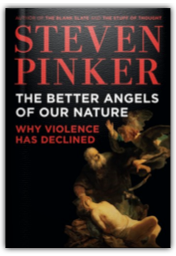
The Better Angels of Our Nature: Why Violence Has Declined Steven Pinker  
More Details

The author of The New York Times bestseller The Stuff of Thought offers a controversial history of violence.
Faced with the ceaseless stream of news about war, crime, and terrorism, one could easily think we live in the most violent age ever seen. Yet as New York Times bestselling author Steven Pinker shows in this startling and engaging new work, just the opposite is true: violence has been diminishing for millennia and we may be living in the most peaceful time in our species's existence. For most of history, war, slavery, infanticide, child abuse, assassinations, pogroms, gruesome punishments, deadly quarrels, and genocide were ordinary features of life. But today, Pinker shows (with the help of more than a hundred graphs and maps) all these forms of violence have dwindled and are widely condemned. How has this happened?

This groundbreaking book continues Pinker's exploration of the essence of human nature, mixing psychology and history to provide a remarkable picture of an increasingly nonviolent world. The key, he explains, is to understand our intrinsic motives- the inner demons that incline us toward violence and the better angels that steer us away-and how changing circumstances have allowed our better angels to prevail. Exploding fatalist myths about humankind's inherent violence and the curse of modernity, this ambitious and provocative book is sure to be hotly debated in living rooms and the Pentagon alike, and will challenge and change the way we think about our society.

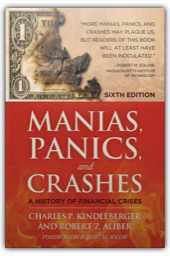
Manias, Panics and Crashes: A History of Financial Crises Charles P. Kindleberger, Robert Z. Aliber  
More Details

Selected as one of the best investment books of all time by the Financial Times, Manias, Panics and Crashes puts the turbulence of the financial world in perspective. Here is a vivid and entertaining account of how reckless decisions and a poor handling of money have led to financial explosions over the centuries. Covering topics such as the history and anatomy of crises, speculative manias, and the lender of last resort, this book has been hailed as "a true classic . . . both timely and timeless." In this new, updated sixth edition, Kindleberger and Aliber expand upon the ideas presented in the previous edition to bring the history of the financial crisis up-to-date.  It now includes two new chapters that provide an in-depth analysis of the causes, consequences and policy responses to the first global crisis of the 21st century, the Financial Crisis of 2007-2008.  In addition, these new chapters also cover significant crises of the last fifteen years.  The authors offer valuable lessons that will allow the reader to successfully navigate the financial crises of today and ones that lie ahead.
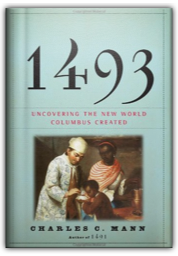
1493: Uncovering the New World Columbus Created Charles C. Mann  
More Details

From the author of 1491—the best-selling study of the pre-Columbian Americas—a deeply engaging new history of the most momentous biological event since the death of the dinosaurs.

More than 200 million years ago, geological forces split apart the continents. Isolated from each other, the two halves of the world developed radically different suites of plants and animals. When Christopher Columbus set foot in the Americas, he ended that separation at a stroke. Driven by the economic goal of establishing trade with China, he accidentally set off an ecological convulsion as European vessels carried thousands of species to new homes across the oceans.

The Columbian Exchange, as researchers call it, is the reason there are tomatoes in Italy, oranges in Florida, chocolates in Switzerland, and chili peppers in Thailand. More important, creatures the colonists knew nothing about hitched along for the ride. Earthworms, mosquitoes, and cockroaches; honeybees, dandelions, and African grasses; bacteria, fungi, and viruses; rats of every description—all of them rushed like eager tourists into lands that had never seen their like before, changing lives and landscapes across the planet.

Eight decades after Columbus, a Spaniard named Legazpi succeeded where Columbus had failed. He sailed west to establish continual trade with China, then the richest, most powerful country in the world. In Manila, a city Legazpi founded, silver from the Americas, mined by African and Indian slaves, was sold to Asians in return for silk for Europeans. It was the first time that goods and people from every corner of the globe were connected in a single worldwide exchange. Much as Columbus created a new world biologically, Legazpi and the Spanish empire he served created a new world economically.

As Charles C. Mann shows, the Columbian Exchange underlies much of subsequent human history. Presenting the latest research by ecologists, anthropologists, archaeologists, and historians, Mann shows how the creation of this worldwide network of ecological and economic exchange fostered the rise of Europe, devastated imperial China, convulsed Africa, and for two centuries made Mexico City—where Asia, Europe, and the new frontier of the Americas dynamically interacted—the center of the world. In such encounters, he uncovers the germ of today’s fiercest political disputes, from immigration to trade policy to culture wars.

In 1493, Charles Mann gives us an eye-opening scientific interpretation of our past, unequaled in its authority and fascination.

Getting Off Track: How Government Actions and Interventions Caused, Prolonged, and Worsened the Financial Crisis John B. Taylor  
More Details

AN EMPIRICAL ANALYSIS OF WHAT WENT WRONG

Throughout history, financial crises have always been caused by excesses—frequently monetary excesses—which lead to a boom and an inevitable bust. In our current crisis it was a housing boom and bust that in turn led to financial turmoil in the United States and other countries. How did everything deteriorate so suddenly and dramatically? In Getting Off Track: How Government Actions and Interventions Caused, Prolonged, and Worsened the Financial Crisis, Hoover fellow and Stanford economist John B. Taylor offers empirical research to explain what caused the current financial crisis, what prolonged it, and what worsened it dramatically more than a year after it began.

The author tells how unusually easy monetary policy helped set the crisis in motion, as interest rates at the Federal Reserve and several other central banks deviated from historical regularities. He explains monetary interaction with the subprime mortgage problem, showing how the use of these mortgages, especially the adjustable-rate variety, led to excessive risk taking. In the United States this was encouraged by government programs designed to promote home ownership, a worthwhile goal but overdone in retrospect. Looking ahead, the author suggests a set of principles to follow to prevent misguided actions and interventions in the future.

The Age of Abundance: How Prosperity Transformed America's Politics and Culture Brink Lindsey  
More Details

Until the 1950s, the struggle to feed, clothe, and employ the nation drove most of American political life. From slavery to the New Deal, political parties organized around economic interests and engaged in fervent debate over the best allocation of agonizingly scarce resources. But with the explosion of the nation's economy in the years after World War II, a new set of needs began to emerge—a search for meaning and self-expression on one side, and a quest for stability and a return to traditional values on the other.
In The Age of Abundance, Brink Lindsey offers a bold reinterpretation of the latter half of the twentieth century. In this sweeping history of postwar America, the tumult of racial and gender politics, the rise of the counterculture, and the conservative revolution of the 1980s and 1990s are portrayed in an entirely new light. Readers will learn how and why the contemporary ideologies of left and right emerged in response to the novel challenges of mass prosperity.

The political ideas that created the culture wars, however, have now grown obsolete. As the Washington Post aptly summarized Lindsey's take on the contradictions of American politics, "Republicans want to go home to the United States of the 1950s while Democrats want to work there." Struggling to replace today's stale conflicts is a new consensus that mixes the social freedom of the left with the economic freedom of the right into a potentially powerful ethos of libertarianism. The Age of Abundance reveals the secret formula of this remarkable alchemy. The book is a breathtaking reevaluation of our recent past—and will change the way we think about the future.

Islands of Genius: The Bountiful Mind of the Autistic, Acquired, and Sudden Savant Darold A. Treffert  
More Details

Savant syndrome is a rare condition in which individuals with developmental disorders, including autism spectrum disorders, have one or more areas of expertise, ability, or brilliance - "islands of genius" - that exist in contrast with their overall limitations. In this fascinating book, Dr. Darold Treffert looks at what we know about this remarkable condition, and at new discoveries that raise interesting questions about the hidden brain potential within us all. Dr. Treffert explores the phenomena of genetic memory - instances in which individuals somehow "know" things they never learned - and sudden genius or "acquired savantism" - where a neuro-typical person unexpectedly and spectacularly develops savant-like abilities following a head injury or stroke. Showing that these phenomena point convincingly towards a reservoir of untapped potential - an inner savant capacity - within us all, he looks both at how savant skills can be nurtured, and how they can help the person who has them, particularly if that person is on the autism spectrum. A central colour section contains the extraordinary artwork of some of the savants who are mentioned in the book. "Islands of Genius" will intrigue anyone who has ever wondered what makes the mind of a savant tick, as well as clinicians, parents, teachers, therapists, and others who care for, and about, individuals with savant syndrome.