
How to Communicate: The Ultimate Guide to Improving Your Personal and Professional Relationships Martha Davis/ Patrick Fanning/ Matthew McKay 

What Intelligence Tests Miss: The Psychology of Rational Thought Keith E. Stanovich PhD (Psychology)
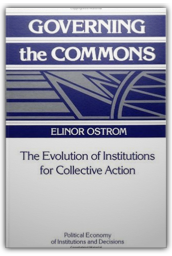
The governance of natural resources used by many individuals in common is an issue of increasing concern to policy analysts. Both state control and privatization of resources have been advocated, but neither the state nor the market have been uniformly successful in solving common pool resource problems. After critiquing the foundations of policy analysis as applied to natural resources, Elinor Ostrom here provides a unique body of empirical data to explore conditions under which common pool resource problems have been satisfactorily or unsatisfactorily solved. Dr. Ostrom first describes three models most frequently used as the foundation for recommending state or market solutions. She then outlines theoretical and empirical alternatives to these models in order to illustrate the diversity of possible solutions. In the following chapters she uses institutional analysis to examine different ways—both successful and unsuccessful—of governing the commons. In contrast to the proposition of the tragedy of the commons argument, common pool problems sometimes are solved by voluntary organizations rather than by a coercive state. Among the cases considered are communal tenure in meadows and forests, irrigation communities and other water rights, and fisheries. 
Devastated by her husband’s death, Earth-based biologist Yoshiko Sunadomari journeys to the paradise world of Fulgar to see her estranged son in the hope of bridging the gulf between them. But Tetsuo is in trouble. His expertise in mu-space technology and family links with the mysterious Pilots have ensured his survival—so far. Now he’s in way over his head—unwittingly caught up in a conspiracy of illegal tech-trafficking and corruption, and in the sinister machinations of one of Fulgar’s ruling elite: the charismatic Luculentus, Rafael Garcia de la Vega. When his home is attacked, Tetsuo flees to the planet’s unterraformed wastes, home to society’s outcasts and eco-terrorists. So Yoshiko arrives on Fulgar to discover Tetsuo gone…and wanted for murder. Ill at ease in this strange, stratified new world seething with social and political unrest but desperate to find her son and clear his name, she embarks on a course of action that will bring her face to face with the awesome, malevolent mind of Rafael. 
The real-time profits from this book's proven Seasonal Timing Strategy alone, even through the 2000-2002 bear market (with no down years) make it a must-own for every investor! And in it Sy Harding now introduces his new equally remarkable Presidential-Cycle Seasonal Strategy! 
Once, not so long ago,a warlock named Vond built an empire in the southern part of the Small Kingdoms. Vond is gone, but his empire survives under the rule of a seven-person Imperial Council and a young regent named Sterren. |
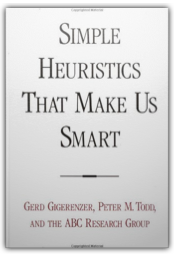
Simple Heuristics That Make Us Smart invites readers to embark on a new journey into a land of rationality that differs from the familiar territory of cognitive science and economics. Traditional views of rationality tend to see decision makers as possessing superhuman powers of reason, limitless knowledge, and all of eternity in which to ponder choices. To understand decisions in the real world, we need a different, more psychologically plausible notion of rationality, and this book provides it. It is about fast and frugal heuristics—simple rules for making decisions when time is pressing and deep thought an unaffordable luxury. These heuristics can enable both living organisms and artificial systems to make smart choices, classifications, and predictions by employing bounded rationality. 
New Dreams for Old is a collection of science fiction and fantasy stories by Mike Resnick, showing the depth and range that has not only made him a popular seller, but also placed him fourth (and climbing) on the all-time award list of all science fiction writers living and dead (as compiled by Locus). 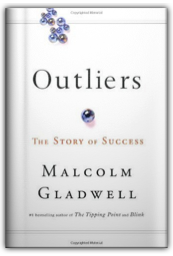
In this stunning new book, Malcolm Gladwell takes us on an intellectual journey through the world of "outliers"—the best and the brightest, the most famous and the most successful. He asks the question: what makes high-achievers different? His answer is that we pay too much attention to what successful people are like, and too little attention to where they are from: that is, their culture, their family, their generation, and the idiosyncratic experiences of their upbringing. Along the way he explains the secrets of software billionaires, what it takes to be a great soccer player, why Asians are good at math, and what made the Beatles the greatest rock band. 
Since the crime explosion of the 1960s, the prison population in the United States has multiplied fivefold, to one prisoner for every hundred adults—a rate unprecedented in American history and unmatched anywhere in the world. Even as the prisoner head count continues to rise, crime has stopped falling, and poor people and minorities still bear the brunt of both crime and punishment. When Brute Force Fails explains how we got into the current trap and how we can get out of it: to cut both crime and the prison population in half within a decade. 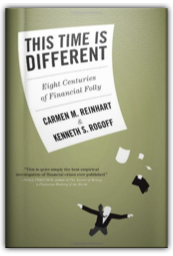
Throughout history, rich and poor countries alike have been lending, borrowing, crashing—and recovering—their way through an extraordinary range of financial crises. Each time, the experts have chimed, "this time is different"—claiming that the old rules of valuation no longer apply and that the new situation bears little similarity to past disasters. This book proves that premise wrong. Covering sixty-six countries across five continents, This Time Is Different presents a comprehensive look at the varieties of financial crises, and guides us through eight astonishing centuries of government defaults, banking panics, and inflationary spikes—from medieval currency debasements to today's subprime catastrophe. Carmen Reinhart and Kenneth Rogoff, leading economists whose work has been influential in the policy debate concerning the current financial crisis, provocatively argue that financial combustions are universal rites of passage for emerging and established market nations. The authors draw important lessons from history to show us how much—or how little—we have learned. 
You don't have to be crazy to talk to yourself! We all talk to ourselves all of the time, usually without realising it. And most of what we tell ourselves is negative, counterproductive and damaging, preventing us from enjoying a fulfilled and successful life. Shad Helmsetter's simple but profound techniques, based on an understanding of the processes of the human brain, have enabled thousands of people to get back in control of their lives. By learning how to talk to yourself in new ways, you will notice a dramatic improvement in all areas of your life. You will feel better and accomplish more. It will help you achieve more at work and at home, lose weight, overcome fears, stop smoking and become more confident. And it works. Shad Helmsetter, Ph.D, is a bestselling author of many personal growth books, and the leading authority in the field of Self-Talk. 
Many think that happiness, like success, comes from getting what they want. But new evidence from positive psychology suggests that happiness is something else, or at least something more. Presenting surprisingly practical wisdom in a playful and entertaining format, Rob Mack delivers a simple-to-follow instruction manual, based in both science and personal experience, for living a happier, healthier, and wealthier life, starting today. |

Peter McCluskey
Collection Total:
1423 Items
1423 Items
Last Updated:
Jan 20, 2012
Jan 20, 2012

 Made with Delicious Library