The Better Angels of Our Nature: Why Violence Has Declined
Steven Pinker
The author of The New York Times bestseller The Stuff of Thought offers a controversial history of violence.
Faced with the ceaseless stream of news about war, crime, and terrorism, one could easily think we live in the most violent age ever seen. Yet as New York Times bestselling author Steven Pinker shows in this startling and engaging new work, just the opposite is true: violence has been diminishing for millennia and we may be living in the most peaceful time in our species's existence. For most of history, war, slavery, infanticide, child abuse, assassinations, pogroms, gruesome punishments, deadly quarrels, and genocide were ordinary features of life. But today, Pinker shows (with the help of more than a hundred graphs and maps) all these forms of violence have dwindled and are widely condemned. How has this happened?
This groundbreaking book continues Pinker's exploration of the essence of human nature, mixing psychology and history to provide a remarkable picture of an increasingly nonviolent world. The key, he explains, is to understand our intrinsic motives- the inner demons that incline us toward violence and the better angels that steer us away-and how changing circumstances have allowed our better angels to prevail. Exploding fatalist myths about humankind's inherent violence and the curse of modernity, this ambitious and provocative book is sure to be hotly debated in living rooms and the Pentagon alike, and will challenge and change the way we think about our society.
0670022950
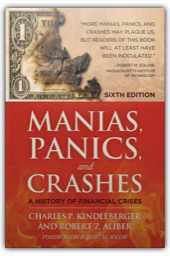
Manias, Panics and Crashes: A History of Financial Crises
Charles P. Kindleberger, Robert Z. Aliber
Selected as one of the best investment books of all time by the Financial Times, Manias, Panics and Crashes puts the turbulence of the financial world in perspective. Here is a vivid and entertaining account of how reckless decisions and a poor handling of money have led to financial explosions over the centuries. Covering topics such as the history and anatomy of crises, speculative manias, and the lender of last resort, this book has been hailed as "a true classic . . . both timely and timeless." In this new, updated sixth edition, Kindleberger and Aliber expand upon the ideas presented in the previous edition to bring the history of the financial crisis up-to-date. It now includes two new chapters that provide an in-depth analysis of the causes, consequences and policy responses to the first global crisis of the 21st century, the Financial Crisis of 2007-2008. In addition, these new chapters also cover significant crises of the last fifteen years. The authors offer valuable lessons that will allow the reader to successfully navigate the financial crises of today and ones that lie ahead.
0230365353
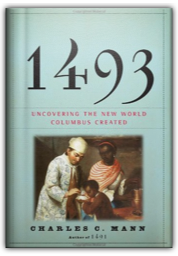
1493: Uncovering the New World Columbus Created
Charles C. Mann
From the author of 1491—the best-selling study of the pre-Columbian Americas—a deeply engaging new history of the most momentous biological event since the death of the dinosaurs.

More than 200 million years ago, geological forces split apart the continents. Isolated from each other, the two halves of the world developed radically different suites of plants and animals. When Christopher Columbus set foot in the Americas, he ended that separation at a stroke. Driven by the economic goal of establishing trade with China, he accidentally set off an ecological convulsion as European vessels carried thousands of species to new homes across the oceans.
The Columbian Exchange, as researchers call it, is the reason there are tomatoes in Italy, oranges in Florida, chocolates in Switzerland, and chili peppers in Thailand. More important, creatures the colonists knew nothing about hitched along for the ride. Earthworms, mosquitoes, and cockroaches; honeybees, dandelions, and African grasses; bacteria, fungi, and viruses; rats of every description—all of them rushed like eager tourists into lands that had never seen their like before, changing lives and landscapes across the planet.
Eight decades after Columbus, a Spaniard named Legazpi succeeded where Columbus had failed. He sailed west to establish continual trade with China, then the richest, most powerful country in the world. In Manila, a city Legazpi founded, silver from the Americas, mined by African and Indian slaves, was sold to Asians in return for silk for Europeans. It was the first time that goods and people from every corner of the globe were connected in a single worldwide exchange. Much as Columbus created a new world biologically, Legazpi and the Spanish empire he served created a new world economically.
As Charles C. Mann shows, the Columbian Exchange underlies much of subsequent human history. Presenting the latest research by ecologists, anthropologists, archaeologists, and historians, Mann shows how the creation of this worldwide network of ecological and economic exchange fostered the rise of Europe, devastated imperial China, convulsed Africa, and for two centuries made Mexico City—where Asia, Europe, and the new frontier of the Americas dynamically interacted—the center of the world. In such encounters, he uncovers the germ of today’s fiercest political disputes, from immigration to trade policy to culture wars.
In 1493, Charles Mann gives us an eye-opening scientific interpretation of our past, unequaled in its authority and fascination.
0307265722
Getting Off Track: How Government Actions and Interventions Caused, Prolonged, and Worsened the Financial Crisis
John B. Taylor
AN EMPIRICAL ANALYSIS OF WHAT WENT WRONG

Throughout history, financial crises have always been caused by excesses—frequently monetary excesses—which lead to a boom and an inevitable bust. In our current crisis it was a housing boom and bust that in turn led to financial turmoil in the United States and other countries. How did everything deteriorate so suddenly and dramatically? In Getting Off Track: How Government Actions and Interventions Caused, Prolonged, and Worsened the Financial Crisis, Hoover fellow and Stanford economist John B. Taylor offers empirical research to explain what caused the current financial crisis, what prolonged it, and what worsened it dramatically more than a year after it began.
The author tells how unusually easy monetary policy helped set the crisis in motion, as interest rates at the Federal Reserve and several other central banks deviated from historical regularities. He explains monetary interaction with the subprime mortgage problem, showing how the use of these mortgages, especially the adjustable-rate variety, led to excessive risk taking. In the United States this was encouraged by government programs designed to promote home ownership, a worthwhile goal but overdone in retrospect. Looking ahead, the author suggests a set of principles to follow to prevent misguided actions and interventions in the future.
0817949712
The Age of Abundance: How Prosperity Transformed America's Politics and Culture
Brink Lindsey
Until the 1950s, the struggle to feed, clothe, and employ the nation drove most of American political life. From slavery to the New Deal, political parties organized around economic interests and engaged in fervent debate over the best allocation of agonizingly scarce resources. But with the explosion of the nation's economy in the years after World War II, a new set of needs began to emerge—a search for meaning and self-expression on one side, and a quest for stability and a return to traditional values on the other.
In The Age of Abundance, Brink Lindsey offers a bold reinterpretation of the latter half of the twentieth century. In this sweeping history of postwar America, the tumult of racial and gender politics, the rise of the counterculture, and the conservative revolution of the 1980s and 1990s are portrayed in an entirely new light. Readers will learn how and why the contemporary ideologies of left and right emerged in response to the novel challenges of mass prosperity.
The political ideas that created the culture wars, however, have now grown obsolete. As the Washington Post aptly summarized Lindsey's take on the contradictions of American politics, "Republicans want to go home to the United States of the 1950s while Democrats want to work there." Struggling to replace today's stale conflicts is a new consensus that mixes the social freedom of the left with the economic freedom of the right into a potentially powerful ethos of libertarianism. The Age of Abundance reveals the secret formula of this remarkable alchemy. The book is a breathtaking reevaluation of our recent past—and will change the way we think about the future.
B0048BPF0W
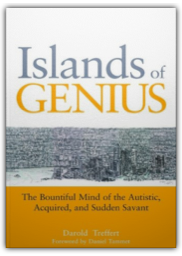
Islands of Genius: The Bountiful Mind of the Autistic, Acquired, and Sudden Savant
Darold A. Treffert
Savant syndrome is a rare condition in which individuals with developmental disorders, including autism spectrum disorders, have one or more areas of expertise, ability, or brilliance - "islands of genius" - that exist in contrast with their overall limitations. In this fascinating book, Dr. Darold Treffert looks at what we know about this remarkable condition, and at new discoveries that raise interesting questions about the hidden brain potential within us all. Dr. Treffert explores the phenomena of genetic memory - instances in which individuals somehow "know" things they never learned - and sudden genius or "acquired savantism" - where a neuro-typical person unexpectedly and spectacularly develops savant-like abilities following a head injury or stroke. Showing that these phenomena point convincingly towards a reservoir of untapped potential - an inner savant capacity - within us all, he looks both at how savant skills can be nurtured, and how they can help the person who has them, particularly if that person is on the autism spectrum. A central colour section contains the extraordinary artwork of some of the savants who are mentioned in the book. "Islands of Genius" will intrigue anyone who has ever wondered what makes the mind of a savant tick, as well as clinicians, parents, teachers, therapists, and others who care for, and about, individuals with savant syndrome.
1849058733
Islands of Genius: The Bountiful Mind of the Autistic, Acquired, and Sudden Savant
Darold A. Treffert
Savant syndrome is a rare condition in which individuals with developmental disorders, including autism spectrum disorders, have one or more areas of expertise, ability, or brilliance - "islands of genius" - that exist in contrast with their overall limitations. In this fascinating book, Dr. Darold Treffert looks at what we know about this remarkable condition, and at new discoveries that raise interesting questions about the hidden brain potential within us all. Dr. Treffert explores the phenomena of genetic memory - instances in which individuals somehow "know" things they never learned - and sudden genius or "acquired savantism" - where a neuro-typical person unexpectedly and spectacularly develops savant-like abilities following a head injury or stroke. Showing that these phenomena point convincingly towards a reservoir of untapped potential - an inner savant capacity - within us all, he looks both at how savant skills can be nurtured, and how they can help the person who has them, particularly if that person is on the autism spectrum. A central colour section contains the extraordinary artwork of some of the savants who are mentioned in the book. "Islands of Genius" will intrigue anyone who has ever wondered what makes the mind of a savant tick, as well as clinicians, parents, teachers, therapists, and others who care for, and about, individuals with savant syndrome.
1849058733
|
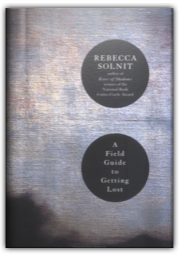
A Field Guide to Getting Lost
Rebecca Solnit
With such acclaimed books as River of Shadows and Wanderlust, activist and cultural historian Rebecca Solnit has emerged as one of the most original and penetrating writers at work today. Her brilliant new book, A Field Guide to Getting Lost, is about the stories we use to navigate our way through the world and the places we traverse, from wilderness to cities, in finding ourselves or losing ourselves. Written as a series of autobiographical essays, it draws on emblematic moments and relationships in Solnit’s own life to explore issues of uncertainty, trust, loss, memory, desire, and place. While deeply personal, Solnit’s book is not just a memoir, since her own stories link up with everything from the captivity narratives of early American immigrants to endangered species to the use of the color blue in Renaissance painting—not to mention encounters with tortoises, monks, punk rockers, mountains, deserts, and the movie Vertigo. The result is a distinctive, stimulating voyage of discovery that only a writer of Solnit’s caliber and curiosity could produce, a book that will appeal not only to her growing legion of admirers but also to the readers of Anne Lamott, Diane Ackerman, and Annie Dillard.

0670034215
Cryoburn
Lois McMaster Bujold
Kibou-daini is a planet obsessed with cheating death. All well and good, so long as they kept to themselves. But now the Kibou-daini are attempting to franchise out their Fountain of Youth wares to the rest of the galaxy and the Barrayar Galactic Empire is none too pleased with the implications.

Cue Miles Vorkosigan, malformed royal troublemaker—but also heir and savior of empire. On Kibou-daini, Miles unearths a war of generations as the oldsters in charge refuse to die and their descendants threaten outright patricide, matricide and maybe even genocide—the prize being a big fat slice of the immortality pie. Bribery, corruption, conspiracy, kidnapping–something is rotten on Kibou-daini, and Miles is up to his neck in trouble and adventure once more.
About Cryoburn:
“Fans have been clamoring for Hugo winner Bujold to pen a new Vorkosigan Saga novel. . . her deft and absorbing writing easily corrals the complex plot.”—Publishers Weekly
About Lois McMaster Bujold’s Vorkosigan Saga:
“Bujold mixes quirky humor with action [and] superb character development…[E]normously satisfying.”—Publishers Weekly.
“One of sf’s outstanding talents . . . an outstanding series.”—Booklist
“. . . an intelligent, well-crafted and thoroughly satisfying blend of adventure, sociopolitical commentary, scientific experiments, and occasional perils . . . with that extra spicing of romance. . . .”—Locus
About Vorkosigan series entry Diplomatic Immunity:
“Bujold is adept at world-building and provides a witty, character-centered plot, full of exquisite grace notes. . . fans will be thoroughly gripped and likely to finish the book in a single sitting.”—Publishers Weekly
1451637500
Catching Fire
Suzanne Collins
Against all odds, Katniss Everdeen has won the annual Hunger Games with fellow district tribute Peeta Mellark. But it was a victory won by defiance of the Capitol and their harsh rules. Katniss and Peeta should be happy. After all, they have just won for themselves and their families a life of safety and plenty. But there are rumors of rebellion among the subjects, and Katniss and Peeta, to their horror, are the faces of that rebellion. The Capitol is angry. The Capitol wants revenge.
0439023491
Thinking, Fast and Slow
Daniel Kahneman
A New York Times Top 10 Book for 2011 A Globe and Mail Best Books of the Year 2011 Title One of The Economist’s 2011 Books of the Year One of The Wall Steet Journal's Best Nonfiction Books of the Year 2011
Daniel Kahneman, recipient of the Nobel Prize in Economic Sciences for his seminal work in psychology that challenged the rational model of judgment and decision making, is one of our most important thinkers. His ideas have had a profound and widely regarded impact on many fields—including economics, medicine, and politics—but until now, he has never brought together his many years of research and thinking in one book.
In the highly anticipated Thinking, Fast and Slow, Kahneman takes us on a groundbreaking tour of the mind and explains the two systems that drive the way we think. System 1 is fast, intuitive, and emotional; System 2 is slower, more deliberative, and more logical. Kahneman exposes the extraordinary capabilities—and also the faults and biases—of fast thinking, and reveals the pervasive influence of intuitive impressions on our thoughts and behavior. The impact of loss aversion and overconfidence on corporate strategies, the difficulties of predicting what will make us happy in the future, the challenges of properly framing risks at work and at home, the profound effect of cognitive biases on everything from playing the stock market to planning the next vacation—each of these can be understood only by knowing how the two systems work together to shape our judgments and decisions.
Engaging the reader in a lively conversation about how we think, Kahneman reveals where we can and cannot trust our intuitions and how we can tap into the benefits of slow thinking. He offers practical and enlightening insights into how choices are made in both our business and our personal lives—and how we can use different techniques to guard against the mental glitches that often get us into trouble. Thinking, Fast and Slow will transform the way you think about thinking.
0374275637
How to Measure Anything: Finding the Value of Intangibles in Business
Douglas W. Hubbard
Anything can be measured. This bold assertion is the key to solving many problems in business and life in general. The myth that certain things can't be measured is a significant drain on our nation's economy, public welfare, the environment, and even national security. In fact, the chances are good that some part of your life or your professional responsibilities is greatly harmed by a lack of measurement-by you, your firm, or even your government.Building up from simple concepts to illustrate the hands-on yet intuitively easy application of advanced statistical techniques, How to Measure Anything reveals the power of measurement in our understanding of business and the world at large. This insightful and engaging book shows you how to measure those things in your business that until now you may have considered "immeasurable," including technology ROI, organizational flexibility, customer satisfaction, and technology risk. Offering examples that will get you to attempt measurements-even when it seems impossible-this book provides you with the substantive steps for measuring anything, especially uncertainty and risk.Don't wait-listen to this book and find out:-The three reasons why things may seem immeasurable but are not-Inspirational examples of where seemingly impossible measurements were resolved with surprisingly simple methods-How computing the value of information will show that you probably have been measuring all the wrong things-How not to measure risk-Methods for measuring "soft" things like happiness, satisfaction, quality, and more-How to fine-tune human judges to be powerful, calibrated measurement instruments-How you can use the Internet as an instrument of measurementA complete resource with case studies, How to Measure Anything illustrates how author Douglas Hubbard-creator of Applied Information Economics-has used his approach across various industries. You'll learn how any problem, no matter how difficult, ill-defined, or uncertain, can lend itself to measurement using proven methods. Straightforward and easy-to-follow, this is the resource you'll refer to again and again-beyond measure.
0470539399
The Beginning of Infinity: Explanations That Transform the World
David Deutsch
Selected by The New York Times Book Review as a Notable Book of the YearA bold and all-embracing exploration of the nature and progress of knowledge from one of today's great thinkers.
Throughout history, mankind has struggled to understand life's mysteries, from the mundane to the seemingly miraculous. In this important new book, David Deutsch, an award-winning pioneer in the field of quantum computation, argues that explanations have a fundamental place in the universe. They have unlimited scope and power to cause change, and the quest to improve them is the basic regulating principle not only of science but of all successful human endeavor. This stream of ever improving explanations has infinite reach, according to Deutsch: we are subject only to the laws of physics, and they impose no upper boundary to what we can eventually understand, control, and achieve.
In his previous book, The Fabric of Reality, Deutsch describe the four deepest strands of existing knowledge-the theories of evolution, quantum physics, knowledge, and computation-arguing jointly they reveal a unified fabric of reality. In this new book, he applies that worldview to a wide range of issues and unsolved problems, from creativity and free will to the origin and future of the human species. Filled with startling new conclusions about human choice, optimism, scientific explanation, and the evolution of culture, The Beginning of Infinity is a groundbreaking book that will become a classic of its kind.
0670022756
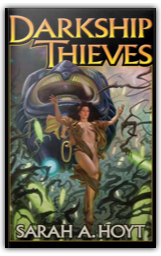
Darkship Thieves
Sarah A. Hoyt
Athena Hera Sinistra never wanted to go to space. Never wanted see the eerie glow of the Powerpods. Never wanted to visit Circum Terra. Never had any interest in finding out the truth about the DarkShips. You always get what you don’t ask for. Which must have been why she woke up in the dark of shipnight, within the greater night of space in her father’s space cruiser, knowing that there was a stranger in her room. In a short time, after taking out the stranger—who turned out to be one of her father’s bodyguards up to no good, she was hurtling away from the ship in a lifeboat to get help. But what she got instead would be the adventure of a lifetime—if she managed to survive. . . .
1439133980
|